

airportstransferstravellogisticsplanning
Best Ski Resorts Near Major Airports: Shortest Transfers
The Mountain Marker Team12 min read
The European ski resorts with the shortest transfers from major airports are Chamonix (1 hour 15 minutes from Geneva), Flaine (1 hour 20 minutes from Geneva), Kitzbuhel (1 hour from multiple Austrian airports), and Mayrhofen (1 hour from Innsbruck). For US travelers, the transfer from airport to resort is the most underestimated part of a European ski trip: after a transatlantic flight, the last thing you want is a four-hour bus ride through mountain passes. Choosing a resort with a short transfer doesn't mean compromising on terrain. Several of the Alps' best ski areas sit within 90 minutes of a major hub airport.
This guide organizes resorts by airport, gives realistic transfer times (not the optimistic ones resorts put in brochures), and covers every transport option from shared buses to rental cars. If you're planning your first European ski trip, start here before you start comparing piste maps.
Why Transfer Time Matters More Than You Think
American skiers are used to driving to resorts. You load the car at home, drive three or four hours to the mountain, and pull into a parking lot. European ski transfers are different in ways that catch first-timers off guard.
The Reality of the Journey
Your door-to-door travel day from the US to a European ski resort typically looks like this:
- Fly from the US to a European hub (8 to 11 hours)
- Clear immigration and customs (30 to 60 minutes)
- Collect luggage and ski bags (20 to 40 minutes)
- Wait for or find your transfer (15 to 45 minutes)
- Drive to the resort (1 to 4 hours depending on the resort)
Steps 1 through 3 are fixed regardless of which resort you choose. Step 5 is the variable, and it matters enormously. A resort that's 1 hour 15 minutes from the airport means you're checking into your accommodation around mid-afternoon if you took a morning flight. A resort that's 3 hours away means you're arriving after dark, exhausted, and you've lost your first evening entirely.
Mountain Roads Aren't Highways
European mountain transfer times assume dry roads and moderate traffic. Add 30 to 60 minutes if it's snowing heavily, a Saturday changeover day (when every resort's worth of visitors is on the same roads), or a holiday weekend. Resorts in deep valleys with single-access roads (like Mayrhofen at the end of the Zillertal, or Val Thorens at the top of the Belleville valley) are more susceptible to delays than resorts with multiple approach routes.
Geneva Airport: The Gateway for American Skiers
Geneva (GVA) is the single most important airport for US skiers heading to the Alps. It has direct flights from New York (JFK), Washington (IAD), and seasonal service from other US cities. The airport sits right on the French-Swiss border, with a dedicated exit into France that lets you skip Swiss customs if you're heading to a French resort.
Resorts Under 1.5 Hours from Geneva
Chamonix, France: 1 Hour 15 Minutes
Chamonix is the closest major ski destination to Geneva and arguably the most dramatic. The town sits at the foot of Mont Blanc, the highest peak in the Alps at 15,774 feet (4,808m), and the scenery rating is a perfect 10 on Mountain Marker's scale.
The transfer is straightforward: autoroute nearly the entire way through the Arve valley, finishing with the approach through the outskirts of the town. In good conditions, you can be standing in Chamonix's town center 75 minutes after leaving the airport terminal.
The catch: Chamonix is an expert-oriented resort. Off-piste scores a perfect 10, and the Vallee Blanche descent is one of the most famous ski runs in the world. But the beginner rating is just 3 out of 10, and the family rating is 4. If you're an advanced or expert skier, this short transfer to world-class terrain is hard to beat. If you're bringing the family or learning to ski, read on.
Transfer options:
- Shared bus services (Easybus, Ouibus): $25 to $40 per person each way
- Private transfer: $200 to $280 for up to 4 passengers
- Rental car: 75 minutes, straightforward route, parking available in town
- Public bus (SNCF/SAT line): $15 per person, roughly 2 hours with stops
Flaine, France: 1 Hour 20 Minutes
Flaine is just 5 minutes further than Chamonix from Geneva but offers a completely different experience. This purpose-built resort in the Grand Massif area scores 10 out of 10 for families and 8 out of 10 for both snow reliability and value, a combination that's almost impossible to find elsewhere.
The drive from Geneva follows the autoroute east, then branches south through the town of Cluses before climbing to Flaine at 5,250 feet (1,600m). The final stretch is a mountain road with hairpin turns that adds time but is well-maintained and regularly plowed.
Transfer options:
- Shared shuttle (BensBus, Skiidy Gonzales): $30 to $45 per person each way
- Private transfer: $220 to $300 for up to 4 passengers
- Rental car: Not recommended; Flaine is car-free and parking is in external lots
Pro tip: Flaine's car-free design means you don't need a vehicle once you arrive. A shared shuttle is the most cost-effective option.
Les Gets, France: 1 Hour 30 Minutes
Les Gets is a traditional French village in the Portes du Soleil ski area, and the transfer from Geneva is fast because it doesn't require climbing deep into the mountains. The route follows the autoroute along the south shore of Lake Geneva before turning into the Vallee Verte, one of the prettiest approaches to any resort in the Alps.
Les Gets is particularly appealing for families (it's a dedicated family resort) and for skiers who want a genuine village atmosphere rather than a purpose-built station. The Portes du Soleil area offers nearly 400 miles (650km) of linked terrain spanning the French-Swiss border.
Transfer options:
- Shared shuttle: $35 to $50 per person each way
- Private transfer: $200 to $280 for up to 4 passengers
- Rental car: Useful here; Les Gets is a real village with easy parking, and having a car lets you explore nearby Morzine and the valley
Resorts 1.5 to 2.5 Hours from Geneva
| Resort | Transfer Time | Key Stats |
|---|---|---|
| Meribel | ~2h 15m | Trois Vallees, 600km, family 9 |
| Val Thorens | ~2h 30m | Highest resort in Europe, snow 10, expert 5 |
| Les Arcs | ~2h 30m | Paradiski 425km, value 7, family 8 |
| Verbier | ~2h | Expert terrain, Four Valleys, expensive |
| Courchevel | ~2h 15m | Trois Vallees, luxury |
These resorts are farther but still manageable on arrival day if you take a morning transatlantic flight. The Trois Vallees cluster (Meribel, Val Thorens, Courchevel) shares the same approach road through Moutiers, which can get extremely congested on Saturday changeover days. If flying into Geneva for these resorts, consider arriving on a Sunday or Friday to avoid the traffic.
Innsbruck Airport: Shortest Transfers in the Alps
Innsbruck (INN) doesn't have direct US flights, but it's easily connected via Munich, Zurich, Frankfurt, or Vienna. The airport sits in the Inn valley, surrounded by ski resorts in every direction, and offers the shortest resort transfers of any Alpine airport. If you're connecting through a European hub anyway, routing through Innsbruck can save hours of mountain driving.
Resorts Under 1.5 Hours from Innsbruck
Mayrhofen, Austria: 1 Hour
Mayrhofen sits at the end of the Zillertal valley, exactly one hour from Innsbruck airport. The drive is almost entirely on valley roads: no mountain passes, no hairpin turns, no altitude gain until you reach the resort itself. This is about as straightforward as a ski transfer gets.
Mayrhofen scores 7 out of 10 on value, 9 on apres-ski, and 7 on family friendliness. The Zillertal area offers 340 miles (544km) on the Superskipass, making it one of the largest ski regions in Austria.
Transfer options:
- Innsbruck airport shuttle (Four Seasons, Zillertal Shuttle): $40 to $55 per person each way
- Rental car: Recommended; the drive is easy and a car is useful for exploring the valley
- Public train + bus: $15 per person, about 1 hour 30 minutes with the connection
Kitzbuhel, Austria: 1 Hour (Multiple Airport Options)
Kitzbuhel is unique on this list because it's accessible from multiple airports in roughly the same time:
- Innsbruck: 1 hour (80km via the autobahn)
- Salzburg: 1 hour 15 minutes (100km)
- Munich: 1 hour 45 minutes (165km via autobahn)
This triple-airport accessibility earns Kitzbuhel an accessibility score of 9 on Mountain Marker's ratings. It means you can comparison-shop flights into three different airports and take whichever offers the best fare, knowing the transfer will be reasonable from any of them.
Kitzbuhel itself is one of the most charming medieval towns in the Alps. The base altitude is low at 2,625 feet (800m), which explains the snow reliability score of just 4 out of 10, but the town's atmosphere, dining (9 out of 10), and apres-ski (9 out of 10) make up for it. Extensive snowmaking covers the main runs.
Transfer options:
- Private transfer from any airport: $150 to $250
- Rental car: Strongly recommended; Kitzbuhel is a real town and having a car is useful
- Train: Kitzbuhel has its own train station with direct connections to Innsbruck (1 hour) and Salzburg (1.5 hours)
Pro tip: Kitzbuhel's train station is right in the town center. If you're connecting through Munich, the train is more pleasant and often faster door-to-door than driving, with no parking to worry about.
St. Anton, Austria: 1 Hour 15 Minutes from Innsbruck
St. Anton is the Arlberg region's most famous resort and one of the best-connected in the Alps. The drive from Innsbruck follows the Inn valley westward on the autobahn, then turns south through the Arlberg tunnel or over the Arlberg pass. In good conditions, it's 1 hour 15 minutes.
St. Anton scores 10 for expert terrain, 10 for apres-ski, and 8 for snow reliability across 190 miles (305km) of pistes. It's the epicenter of Austrian ski culture: the Krazy Kanguruh and Mooserwirt bars are legendary for a reason. The family rating is lower at 5 out of 10, so this is better suited to groups of adult skiers or older teenagers.
Transfer options:
- Private transfer from Innsbruck: $180 to $260
- Rental car: 1 hour 15 minutes, straightforward autobahn driving
- Train: St. Anton has a major train station. Direct trains from Innsbruck take 75 minutes and cost around $20 per person. This is the most civilized way to arrive.
Pro tip: The Arlberg rail tunnel means trains aren't affected by weather. In heavy snowfall, the train can actually be faster than driving.
Alpbach, Austria: 50 Minutes from Innsbruck
Alpbach has one of the shortest transfers from any major airport to any resort in the Alps. Just 50 minutes from Innsbruck, it's ideal for travelers who want to minimize travel time. The ski area is modest at 68 miles (109km), but for a short trip or a family holiday, the convenience factor is hard to beat. Alpbach scores 7 out of 10 on value.
Munich Airport: The US Connection Hub
Munich (MUC) has the most direct US flights of any airport near the Alps, with service from New York, Chicago, Los Angeles, San Francisco, Charlotte, and other cities. The airport is larger and busier than Innsbruck or Geneva, but it connects to Austrian resorts via Germany's excellent autobahn network.
Resorts from Munich
| Resort | Transfer Time | Route Notes |
|---|---|---|
| Kitzbuhel | ~1h 45m | Autobahn nearly the entire way |
| Mayrhofen | ~2h | Via Innsbruck, then Zillertal |
| St. Anton | ~2h 30m | Via Innsbruck, then Arlberg |
| Solden | ~2h 45m | Via Innsbruck, then Otztal |
| Ischgl | ~3h | Via Innsbruck, then Paznaun valley |
Munich transfers are longer than Innsbruck, but the direct US flights can save a connection. If your US departure city has a direct Munich flight, it's often faster total door-to-door than connecting through Zurich or Frankfurt to reach Innsbruck.
Zurich Airport: The Swiss Option
Zurich (ZRH) has direct flights from several US cities and provides access to Swiss and western Austrian resorts. Swiss trains are legendarily punctual, and several resorts can be reached by rail from the airport.
Key Resorts from Zurich
-
Zermatt: 3 hours 30 minutes by train (no driving option; Zermatt is car-free). The scenic rail journey through the Rhone valley is part of the experience. Zermatt offers 224 miles (360km) of pistes, a snow score of 9, and the highest lift-served point in the Alps at 12,739 feet (3,883m).
-
Saas-Fee: 3 hours by train and bus. Another car-free Swiss village with glacier skiing, perfect snow reliability (10 out of 10), and a compact, family-friendly village.
-
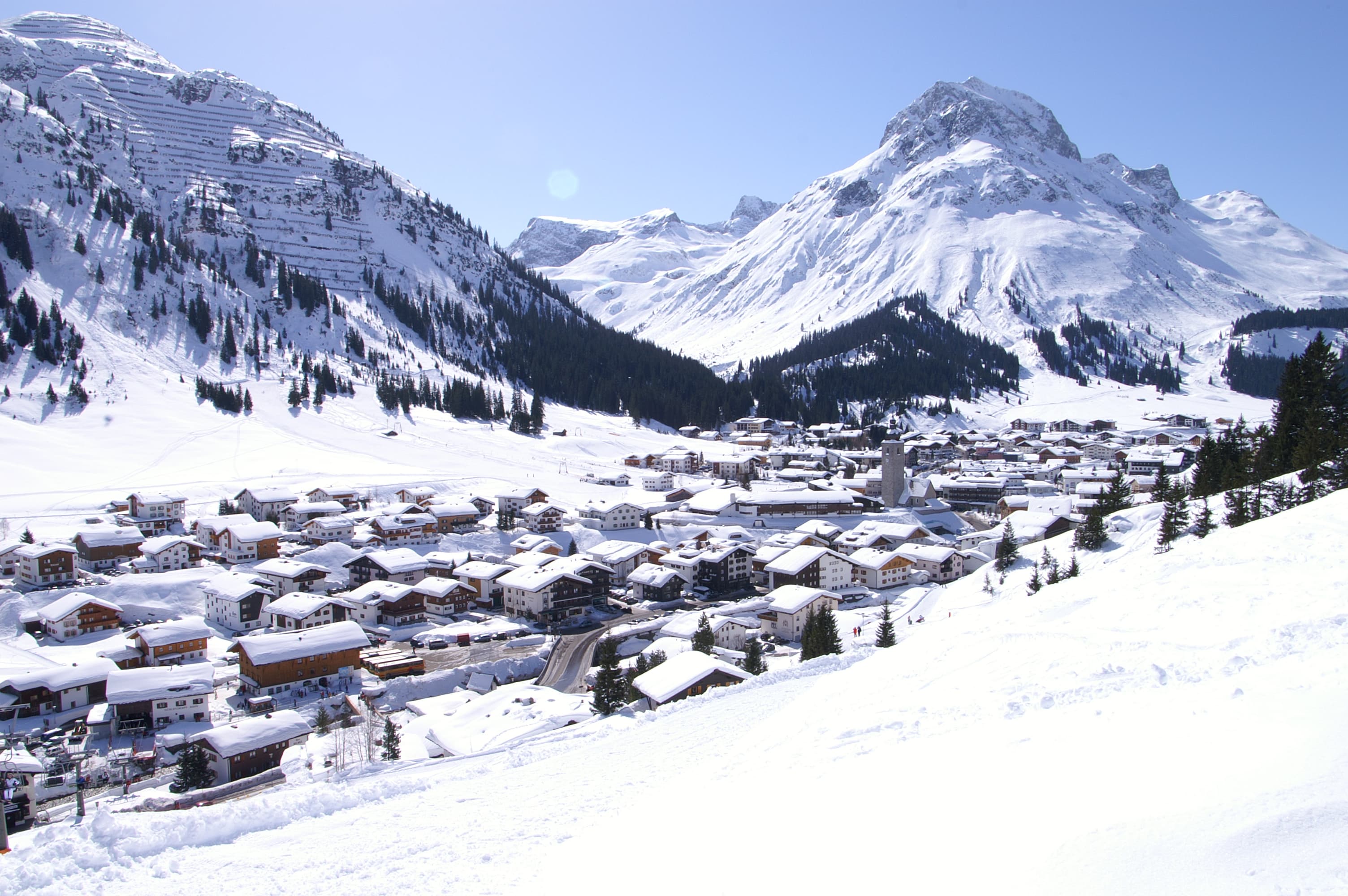
Lech: 2 hours 30 minutes by car via Liechtenstein and the Arlberg. A beautiful drive, but consider the weather risk on the Arlberg pass in winter.
Swiss resorts tend to have longer transfers than Austrian ones, partly because the airports are further from the mountains and partly because Swiss valleys are deeper and roads are more winding. The tradeoff is that the train network is superb and often more relaxing than driving.
Transfer Booking Advice for US Travelers
Shared vs. Private Transfers
Shared shuttles run on fixed schedules (usually timed to common flight arrivals) and cost $25 to $60 per person. They may stop at multiple resorts. Best for: solo travelers, couples, budget-conscious families who can align with the schedule.
Private transfers cost $150 to $350 for up to 4 passengers (roughly $200 to $500 for up to 8). They meet you at the airport and drive directly to your accommodation. Best for: families with young kids, groups of 4 or more (where per-person cost approaches shared rates), late-arriving flights.
Rental Cars: When They Make Sense
A rental car is worthwhile if you're staying in a real town (Kitzbuhel, Mayrhofen, Chamonix) rather than a purpose-built resort, or if you want to explore the surrounding area during the week. A rental car is not worthwhile if you're going to a car-free resort (Flaine, Zermatt, Saas-Fee) where you'll pay for parking and never use the car.
European rental cars are almost always manual transmission. If you need an automatic, book well in advance and expect to pay a premium. You'll also need your US driver's license and, in some countries, an International Driving Permit (IDP). Snow tires or chains are legally required in Austria and recommended everywhere else.
The Train Option
Don't overlook trains. Several major resorts have their own train stations (Kitzbuhel, St. Anton, Chamonix, Zermatt), and others are reached by train plus a short bus or gondola ride. European trains are comfortable, run on time (especially in Switzerland and Austria), and eliminate the stress of mountain driving in unfamiliar conditions. First-class upgrades are affordable and include more luggage space for ski bags.
The Transfer Time Decision Matrix
If transfer time is your top priority, here's the summary:
| Priority | Best Airport | Best Resort | Transfer |
|---|---|---|---|
| Shortest possible | Innsbruck | Alpbach | 50 min |
| Short + expert terrain | Geneva | Chamonix | 1h 15m |
| Short + family friendly | Geneva | Flaine | 1h 20m |
| Short + value | Innsbruck | Mayrhofen | 1h |
| Short + big ski area | Innsbruck | St. Anton | 1h 15m |
| Direct US flights + short | Munich | Kitzbuhel | 1h 45m |
Use Mountain Marker's resort comparison tool to weigh transfer times against other factors like snow reliability, terrain size, and budget.
Plan Your Route to the Alps
Transfer time is one of the most practical factors in choosing a European ski resort, and one that most guidebooks gloss over. Browse all resorts on Mountain Marker to see transfer times, nearest airports, and transport options for every destination. Sort by accessibility rating to find the resorts that get you from the plane to the piste with the least friction.
After a seven-hour transatlantic flight, the difference between a 75-minute transfer and a three-hour one isn't just time: it's the difference between arriving with energy to explore the village and arriving ready to collapse. Choose your airport and resort pairing carefully, and your first European ski trip starts on the right foot.
Where to stay in Lech am Arlberg
Browse hotels and accommodation near Lech am Arlberg.
Find hotels on ExpediaSponsored — we earn a small commission when you book through Expedia. It doesn't cost you more.
 Resort
Lech am Arlberg
Austria
 Resort
Chamonix
France
ArticleThe Complete Guide to Flying from the US to European Ski Resorts
Getting from an American airport to an alpine resort involves more decisions than a typical transatlantic flight. Here's how to navigate the airports, transfers, and timing to arrive on the mountain without the headache.

