

season review2025-26snow forecastLa NinaNOAAFarmer's Almanacsnow reliability
2025-26 Season Review: What Was Predicted vs What Actually Happened
The Mountain Marker Team7 min read
The 2025-26 ski season was supposed to be a La Niña winter — colder and snowier across the northern tier of North America, with above-average precipitation for the Pacific Northwest, Northern Rockies, and Japan. In reality, the season played out far more unevenly than any forecast suggested. The Rocky Mountain West endured one of its worst snow years in decades, the Pacific Northwest collapsed to record lows, and the Northeast quietly delivered one of its strongest seasons in recent memory. Meanwhile, the European Alps started with a bang in November before settling into a frustratingly dry mid-winter. The lesson, as always: forecasts set expectations, but mountains write their own rules.
What the Forecasters Predicted
NOAA's Winter Outlook
NOAA's official outlook, issued in autumn 2025, called for a weak La Niña persisting through the core winter months of December through February. The agency predicted colder-than-average temperatures across the northern Plains through New England, warmer conditions across the southern tier, and above-normal precipitation favoring the Pacific Northwest, Northern Rockies, and Great Lakes region.
For skiers, the signal was clear: head north. Washington's Cascades, Montana, Idaho, and northern Wyoming were supposed to be the sweet spots. Colorado and Utah were forecast as roughly neutral, and the Southwest was expected to trend drier than average.
The Farmer's Almanac
The Old Farmer's Almanac predicted a winter of "dramatic swings and widespread winter weather," with the coldest temperatures concentrated from the northern Plains to New England. The Farmers' Almanac echoed the general La Niña pattern — snow for the north, mild conditions for the south. Both publications marketed confident calls despite independent accuracy assessments placing their hit rates near 50 percent for temperature and precipitation direction.
OpenSnow and AccuWeather
Ski-specific forecasters like OpenSnow cautioned that a weak La Niña would produce less reliable signals than a strong event. AccuWeather called for an active storm track across the northern states, with Colorado seeing a potentially slow start but a mid-season recovery. The consensus: get to the Pacific Northwest or Northern Rockies early, plan Colorado and Utah trips for February and March.
What Actually Happened
The Rocky Mountain Disaster
The biggest story of 2025-26 was the catastrophic underperformance of the Rocky Mountain West. Colorado's April 1 snowpack measured just 22 percent of median — the worst in recorded history. Utah finished with record-low snowpack. Wyoming's Bridger Bowl recorded only 138 inches of snow against a 300-inch seasonal average. Across the region, resorts closed early, terrain remained limited, and the powder days that define a Rocky Mountain winter simply did not materialize.
This was not what any forecast predicted. Even NOAA's neutral-to-slightly-dry outlook for Colorado dramatically understated the severity. The jet stream repeatedly tracked too far north to deliver meaningful storm systems to the central and southern Rockies, and the few storms that did arrive brought warm temperatures that pushed snow lines above resort base elevations.
Pacific Northwest: Record Lows
The biggest forecast miss of the season. La Niña is supposed to favor the Pacific Northwest — that is one of the most reliable signals in the ENSO playbook. Instead, Oregon had its worst ski season on record. Mt. Bachelor's summit opened for a single day through early March. Washington fared only marginally better. The mechanism that typically channels cold, moist air from the North Pacific into the Cascades simply did not engage consistently.
This was a weak La Niña, and weak signals produce weak results. The forecasters hedged with words like "favored" and "above-normal probability," but the public narrative simplified it to "La Niña means Pacific Northwest powder." It did not.
Northeast: The Quiet Winner
While the West suffered, the Northeast and Midwest delivered an outstanding season. Jay Peak finished at 124 percent of normal snowfall. Stowe hit 116 percent. Whiteface reached 135 percent. Sault Ste. Marie, Michigan logged its second-snowiest winter on record with nearly 147 inches. Across the Great Lakes and northern New England, cold temperatures held consistently, snowmaking windows were abundant, and natural snowfall exceeded averages.
The Farmer's Almanac earned real credit here — its "Chill, Snow, Repeat" theme for the Northeast was essentially correct. NOAA's cold-and-wet outlook for the region also verified well.
Canadian Rockies: The Real La Niña Beneficiary
If you wanted the La Niña signal to actually work, you needed to go further north. The Canadian Rockies — Banff, Kicking Horse, Revelstoke — reached record December snowfall totals and maintained strong coverage through the season. British Columbia's interior ranges delivered consistent powder, and Alberta's resorts had their best early season in years.
European Alps: Hot Start, Cold Middle
The Alps began the 2025-26 season with exceptional November snowfall. Over 70 centimeters fell across France, Switzerland, Austria, and Italy in late November, with high-altitude slopes accumulating nearly 1.5 meters before December. The French Northern Alps had the best early conditions of any Alpine country.
Then it stopped. By late December, snow depths across most of the Alps had dropped below average, and some areas went over a month without significant fresh snowfall. Late February brought a partial recovery — particularly for Austrian resorts and higher French stations — but the mid-season drought left many lower-altitude resorts struggling.
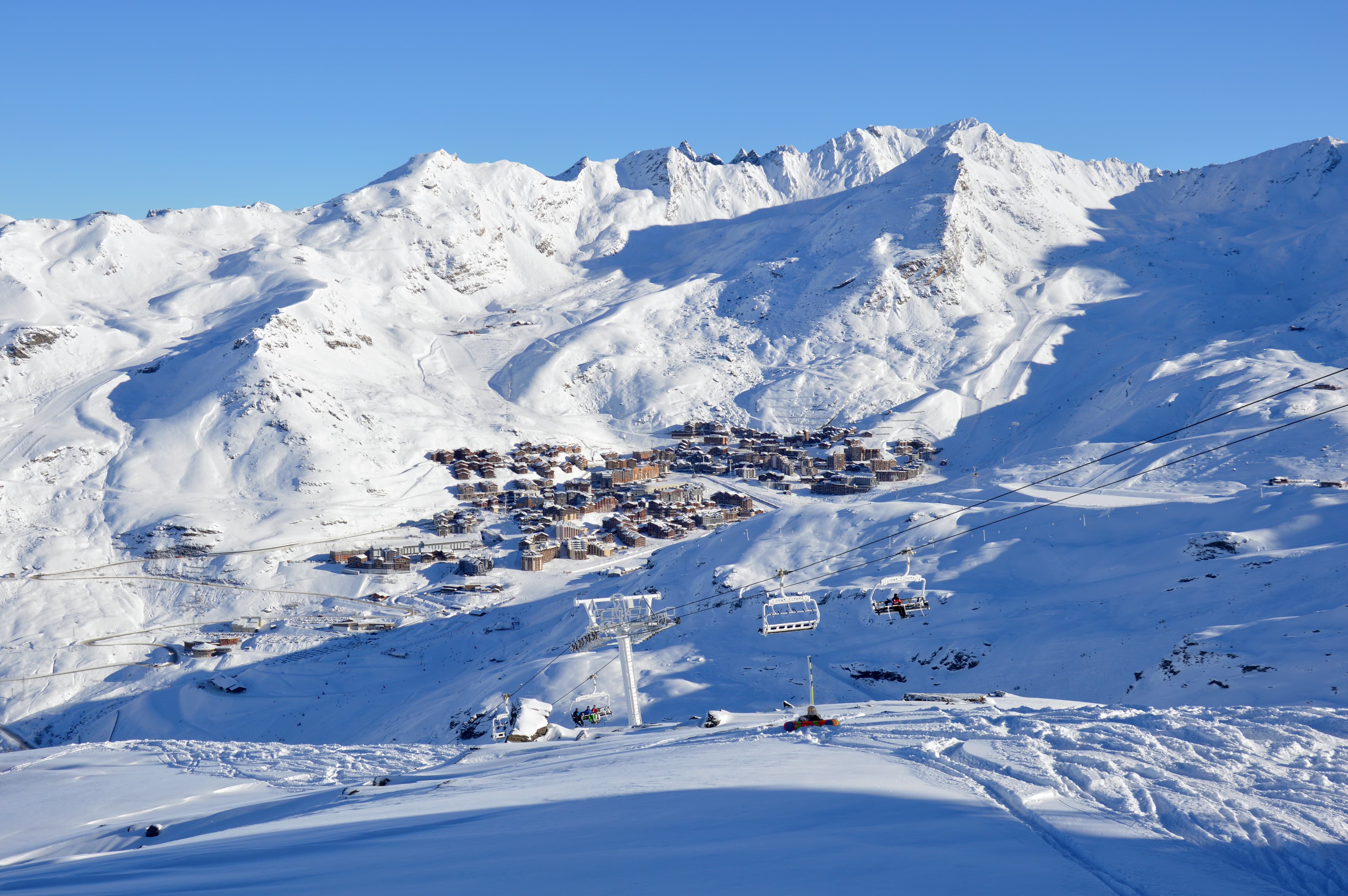
High-altitude resorts like Val Thorens and Tignes weathered the dry spell best, maintaining coverage on their upper terrain through the season. Zermatt leaned on its glacier to keep conditions reliable. Austrian resorts like Obertauern and Lech benefited from late-February storms that replenished their snowpack.
Lower-altitude resorts suffered more. Kitzbuhel, with its 800-meter base village, needed heavy snowmaking to keep runs open during the dry stretch. Resorts below 1,500 meters in the southern Alps faced the toughest conditions.
Japan: Delivering on Promise
Japan's ski season aligned more closely with forecasts. The Japan Meteorological Agency predicted above-average snowfall along the Sea of Japan coast, and Hokkaido largely delivered. Niseko and Hakuba reported strong snowfall totals through mid-season, and the season extended through Golden Week in early May. The La Niña-like Pacific conditions supported the northwesterly winds that drive Japan's famous powder machine.
Scorecard: How the Forecasts Graded Out
NOAA — Grade: B-. Got the Northeast cold and wet call right, and the Canadian Rockies signal was correct. But NOAA missed the Pacific Northwest collapse entirely and dramatically understated the severity of the Rocky Mountain drought.
Farmer's Almanac — Grade: C+. Northeast predictions were strong, and the general cold pattern in the north verified. But the West was completely wrong, and "dramatic swings" was too vague to be useful for actual trip planning.
AccuWeather — Grade: C. Correctly called Colorado's slow start. But the promised mid-season recovery never materialized, and the overall western forecast missed badly.
OpenSnow — Grade: B. Correctly warned that a weak La Niña means weak signals — the most honest framing of any forecaster. Still leaned into Pacific Northwest optimism that did not pan out.
What This Means for Trip Planning
Stop Relying on Seasonal Forecasts Alone
The 2025-26 season demonstrated that even the best forecasters cannot reliably predict snowfall at the resort level months in advance. ENSO phase, Arctic Oscillation, and other teleconnection patterns set broad probabilities, but the specific storms that make or break a ski week are invisible until 7-10 days out.
Seasonal forecasts are useful for understanding which way the odds tilt. They are not useful for booking a specific resort in a specific week and expecting guaranteed conditions.
Prioritize Snow Reliability Scores Over Seasonal Hype
The resorts that performed best in 2025-26 — regardless of region — were the ones with structural advantages: high altitude, glacier access, north-facing terrain, and geographic snow-trap positioning. Val Thorens did not need a big snow year to deliver good skiing because it sits at 2,300 meters with north-facing upper terrain. Obertauern caught what storms there were because of its Alpine ridge position. Zermatt had its glacier as insurance.
Mountain Marker's snow reliability scores account for these structural factors — altitude, aspect, glacier access, snowmaking capacity, and historical consistency. A resort scoring 9 or 10 for snow reliability will deliver acceptable conditions in a bad year and excellent conditions in a good one. A resort scoring 4 or 5 needs the forecast to cooperate.
Diversify Your Booking Strategy
If you are planning a trip 6-12 months out, consider these approaches:
-
Book a high-reliability resort as your anchor. Val Thorens, Tignes, Zermatt, and Obertauern all score 9 or 10 for snow reliability. You are unlikely to regret booking these regardless of what the season delivers.
-
Watch the ENSO phase for your secondary trip. If La Niña is active, consider Japan or the Canadian Rockies. If El Niño develops, look at the Sierra Nevada and Southern Rockies. But treat this as a tiebreaker, not a guarantee.
-
Use flexible cancellation policies. Book accommodation with free cancellation where possible, and monitor short-range forecasts in the two weeks before your trip. The 10-day forecast is dramatically more reliable than the seasonal outlook.
-
Compare resorts using data, not vibes. Use the resort comparison tool to evaluate snow reliability alongside terrain, value, and accessibility for your specific trip priorities.
Looking Ahead: 2026-27
Early indications suggest El Niño conditions may develop for winter 2026-27, which would shift the favored regions toward the Sierra Nevada, Southern Rockies, and parts of the Northeast, while potentially reducing snowfall in the Pacific Northwest and Northern Rockies. But if 2025-26 taught us anything, it is to hold those predictions loosely.
The smartest approach is the same every year: choose resorts with high snow reliability scores, book with flexibility, and let short-range forecasts guide your final timing decisions. Browse all resorts on Mountain Marker to find the ones that deliver regardless of what the atmosphere decides to do.
Where to stay in Val Thorens
Browse hotels and accommodation near Val Thorens.
Find hotels on Expedia →Sponsored — we earn a small commission when you book through Expedia. It doesn't cost you more.
 Resort
Val Thorens
France
ArticleBest Ski Resorts with the Most Reliable Snow
Snow reliability separates a great ski holiday from an expensive walk in brown grass. These European resorts score highest for consistent coverage, thanks to altitude, glaciers, and geography.
 Article
Planning Your 2026/27 Ski Season: Early Bird Deals and Tips
A month-by-month booking calendar for the 2026/27 ski season — when to buy passes, book flights, and lock in accommodation. Written in April 2026 and kept current; see the September 2026 status note for which windows have closed.
