

snow reliabilityhistorical snowfallbest snowhigh altitudeglacier skiingearly seasonlate seasonresort rankings
Historical Snowfall Data: Which Ski Resorts Are Most Reliable for Snow?
The Mountain Marker Team12 min read
Snow reliability is the single most important factor in protecting your ski trip investment. You can choose the perfect resort for terrain, charm, and value — but if you arrive to brown grass and ice, none of it matters. Some resorts deliver strong coverage in virtually every season because of structural advantages — altitude, glaciers, north-facing terrain, and geographic positioning — that are measurable, consistent, and far more predictable than any seasonal weather forecast.
Mountain Marker's snow reliability scores rate every resort from 1 to 10 based on these structural factors plus historical snowfall data and season length consistency. The resorts that score 8 or above are the ones where you can book six months out and feel confident the snow will be there when you arrive. Here are the most reliable resorts in the world, the data behind the rankings, and how to use this information to plan smarter.
What Drives Snow Reliability
Four factors determine whether a resort can consistently deliver good skiing from early December through mid-April — and in some cases, well beyond.
1. Altitude
The simplest and most powerful factor. Higher resorts stay colder, snowfall sticks, and groomed surfaces hold. Every 1,000 feet (300 meters) of elevation gain drops temperatures by roughly 3.5°F (2°C), which is the difference between rain and snow during shoulder-season storms.
The treeline in the European Alps sits at roughly 6,500-7,200 feet (2,000-2,200 meters). Resorts with base villages above that line rarely have coverage problems on their home terrain. Resorts below 4,000 feet (1,200 meters) rely heavily on snowmaking and favorable weather.
In North America, the numbers shift because of latitude and continental climate effects. Colorado resorts benefit from base elevations around 9,000-9,500 feet (2,750-2,900 meters), while Pacific Northwest resorts at 4,000-6,000 feet (1,200-1,800 meters) compensate with massive precipitation volumes.
2. Aspect (Slope Orientation)
North-facing slopes receive less direct sunlight and hold snow significantly longer than south-facing terrain. In the Northern Hemisphere, a north-facing bowl can retain snow coverage weeks after a comparable south-facing slope has turned to slush.
This matters most during shoulder seasons and warm spells. A resort like Flaine, sitting in a large north-facing bowl, scores 8/10 for snow reliability despite a relatively modest base altitude of 5,250 feet (1,600 meters). Alpe d'Huez, with extensive south-facing terrain, gets excellent sunshine but softens faster in spring.
3. Glacier Access
Glaciers are permanent ice fields at extreme altitude. Ski resorts with glacier terrain can offer skiing regardless of seasonal snowfall because the surface itself is ice and compacted snow that persists year-round. Glaciers push ski seasons into May, June, and for some resorts, even summer months.
The major glacier resorts — Zermatt, Saas-Fee, Solden, Tignes, and Hintertux in Austria — treat the glacier as insurance. Even in the worst snow year, the upper mountain delivers.
4. Geographic Snow Traps
Some resorts sit in positions that concentrate snowfall from prevailing weather systems. Obertauern in Austria occupies a bowl formation at 5,740 feet (1,750 meters) on the main Alpine ridge, catching weather from both the north and south. Lech in the Arlberg receives an average of 18 feet (550 centimeters) of snow per season — more than many resorts 1,000 feet higher — because of its position relative to prevailing weather patterns. Japan's Hokkaido resorts benefit from the Sea of Japan Effect, where cold Siberian air masses absorb moisture crossing the sea and dump it on west-facing mountain slopes.
Top 10 Most Snow-Reliable Ski Resorts Worldwide
1. Val Thorens, France — Snow Reliability 10/10
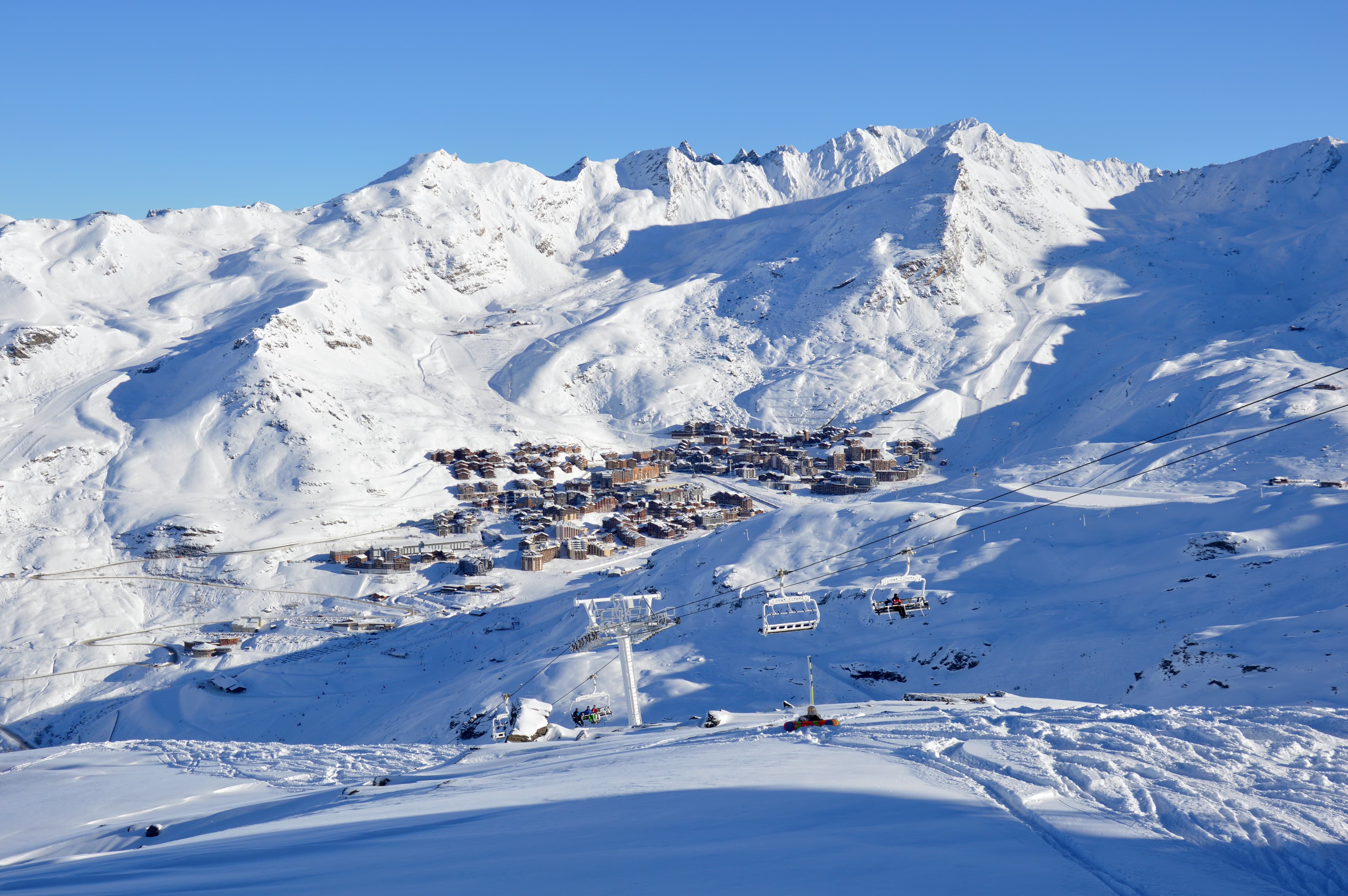
Val Thorens is the highest resort in Europe with a base village at 7,545 feet (2,300 meters) and lifts reaching 10,597 feet (3,230 meters). The entire ski area sits above the treeline, and it anchors the 370-mile (600-kilometer) Trois Vallees — the largest linked ski domain in the world.
Snow reliability here is not a question. Even in the leanest snow years on record, Val Thorens maintains full coverage on its upper terrain. The season regularly runs from late November through early May. In 2025-26, when mid-season drought affected much of the Alps, Val Thorens' altitude kept it operational while lower resorts struggled.
Why it scores 10: Extreme altitude, north-facing upper terrain, consistently long season, and structural protection from warm spells. The trade-off is a purpose-built village without traditional charm and exposed terrain in bad weather.
2. Tignes, France — Snow Reliability 10/10
Tignes shares the Espace Killy ski area with Val d'Isere — 186 miles (300 kilometers) of terrain between 5,085 feet (1,550 meters) and 11,320 feet (3,450 meters). Glacier access on the Grande Motte provides year-round skiing on the upper slopes.
The combination of altitude, glacier backup, and north-facing terrain makes Tignes one of the most snow-secure destinations in the world. The season extends from October (glacier only) through early May for the full ski area.
Why it scores 10: Glacier insurance, extreme upper altitude, and north-facing terrain on the Tignes side combine to eliminate virtually all snow-reliability risk.
3. Obertauern, Austria — Snow Reliability 10/10
Obertauern is the sleeper pick on this list. Sitting in a bowl formation at 5,740 feet (1,750 meters) on the main Alpine divide, it catches weather systems from both the north and south. Average annual snowfall exceeds 16 feet (500 centimeters) — more than many resorts 2,000 feet higher.
The compact, ski-in/ski-out village sits directly on the slopes, so there is no commute from a valley floor to reach the snow. Obertauern also offers outstanding value compared to French and Swiss resorts, making it a strong pick for reliability-conscious travelers on a budget.
Why it scores 10: Geographic snow-trap positioning, moderate-high altitude, compact layout that eliminates low-altitude base village problems, and consistent massive snowfall totals.
4. Zermatt, Switzerland — Snow Reliability 9/10
Zermatt combines glacier skiing on the Klein Matterhorn (reaching 12,740 feet / 3,883 meters) with 224 miles (360 kilometers) of pisted terrain across three valleys. The glacier allows skiing 365 days a year in theory, though the full ski area opens from late November through late April.
Zermatt's snow reliability comes from altitude and glacier access rather than raw snowfall volume. The resort does not receive as much annual snow as Obertauern or Lech, but what falls sticks at those elevations, and the glacier provides a permanent fallback.
Why it scores 9 (not 10): Some lower connecting terrain toward Cervinia on the Italian side is south-facing and can deteriorate in warm spells. The core terrain above 2,500 meters is rock-solid.
5. Lech-Zürs, Austria — Snow Reliability 9/10
Lech sits in the Arlberg region and receives an average of 18 feet (550 centimeters) of snow per season. This is an extraordinary total — driven by the Arlberg's position at the intersection of weather systems from the northwest and the Mediterranean.
The village sits at 4,757 feet (1,450 meters), which is lower than the other resorts on this list, but the massive snowfall volume compensates. Combined with north-facing terrain and a connected ski area shared with St. Anton, Lech-Zürs offers elite snow reliability with genuine Austrian village charm.
Why it scores 9: Exceptional snowfall volume, favorable aspect, Arlberg positioning. The lower base altitude is the only factor preventing a perfect 10.
6. Saas-Fee, Switzerland — Snow Reliability 9/10
Saas-Fee is a car-free village nestled in a north-facing valley at 5,906 feet (1,800 meters), with glacier skiing reaching 11,483 feet (3,500 meters). The Allalin glacier provides year-round skiing, and the north-facing valley orientation preserves snow coverage on lower slopes far longer than comparable altitudes on south-facing terrain.
Why it scores 9: Glacier access, north-facing valley, high altitude, and car-free village character. Limited overall terrain size is the main drawback for extended visits.
7. Sölden, Austria — Snow Reliability 9/10
Solden offers two glacier areas — Rettenbach and Tiefenbach — both above 10,000 feet (3,000 meters). The resort hosts the World Cup season opener in October, which says everything about its early-season readiness.
The skiing extends from the glacier terrain down to a base village at 4,528 feet (1,380 meters). Upper terrain is virtually guaranteed; lower runs depend on the season. In a good year, the entire resort is well-covered. In a lean year, the glaciers carry the experience.
Why it scores 9: Dual glacier access, extreme upper altitude, proven early-season reliability. The lower village elevation means base-area conditions are more variable.
8. Niseko, Japan — Snow Reliability 9/10
Niseko receives an average of roughly 50 feet (15 meters) of snowfall per season — one of the highest totals of any major ski resort on Earth. The Sea of Japan Effect drives cold, moisture-laden Siberian air across open water before it collides with Hokkaido's mountains, producing incredibly light, dry powder in enormous quantities.
Niseko's base altitude is modest — around 2,624 feet (800 meters) — but the extreme snowfall volume and cold Hokkaido temperatures mean coverage is rarely an issue from mid-December through early May. The snow quality is the real draw: Niseko's powder is consistently lighter and drier than what you find in most of Europe or even much of North America.
Why it scores 9: Extreme snowfall volume, consistent cold temperatures, reliable Sea of Japan Effect. Lower altitude means early December and late April can be marginal in weak snow years.
9. Flaine, France — Snow Reliability 8/10
Flaine sits in a large north-facing bowl at 5,250 feet (1,600 meters) within the Grand Massif ski area — 165 miles (265 kilometers) of terrain. The north-facing aspect preserves snow far more effectively than the altitude alone would suggest, and the bowl geography concentrates snowfall.
Flaine is also one of the best-value resorts in France, with a family rating of 10/10 and a value rating of 8/10. For families seeking reliability without the price tag of the Trois Vallees, Flaine is one of the strongest picks in the Alps.
Why it scores 8: North-facing bowl, decent altitude, consistent snow preservation. Lower than the Tier 1 resorts, so extreme warm spells can affect base-area conditions.
10. St. Anton, Austria — Snow Reliability 8/10
St. Anton benefits from the same Arlberg positioning as Lech, receiving heavy snowfall from northwest weather systems. The resort has invested heavily in snowmaking infrastructure to supplement natural coverage on its lower terrain, and the north-facing off-piste terrain holds powder for days after a storm.
St. Anton is the birthplace of Alpine skiing technique and scores 10/10 for both expert terrain and off-piste. Combined with 8/10 snow reliability, it is the top choice for advanced skiers who want both challenge and consistent conditions.
Why it scores 8: Arlberg snowfall volume, north-facing off-piste, strong snowmaking. The lower village elevation (4,278 feet / 1,304 meters) and some south-facing terrain prevent a higher score.
Best Resorts by Season Timing
Snow reliability is not just about total snowfall — it is about when the snow arrives and how long it lasts.
Best for Early Season (November-December)
If you want to ski before Christmas, glacier resorts and extreme-altitude destinations are your safest bets:
- Solden — Opens in October for glacier skiing. Full resort operational by late November in most years.
- Tignes — Glacier opens as early as October. Full Espace Killy area by late November.
- Val Thorens — Altitude means it opens reliably in late November, often with excellent early coverage.
- Zermatt — Glacier skiing is available year-round. The full ski area opens progressively from November.
- Obertauern — Its snow-trap geography often delivers heavy early-season snowfall. Typically opens by late November.
Best for Late Season (April and Beyond)
Spring skiing requires altitude, glaciers, or both. As temperatures rise, only the highest terrain stays in condition:
- Zermatt — Glacier skiing continues through summer. The full area typically operates through late April.
- Val Thorens — Regularly open through early May. Upper slopes hold coverage when lower resorts have closed.
- Tignes — Full area through early May, glacier skiing into summer.
- Saas-Fee — Glacier open year-round. Full area through late April.
- Solden — Glacier skiing extends through spring, with the main season running into late April.
Altitude Matters: The Data
The relationship between altitude and snow reliability is not linear — it is exponential at the margins. A resort at 2,000 meters is significantly more reliable than one at 1,500 meters, but the gap between 2,500 meters and 3,000 meters is smaller because both are well above the freezing threshold for most of the season.
Here is how the resorts on Mountain Marker break down by altitude and snow reliability:
- Above 2,000m base — average snow score 9.2. Notable resorts: Val Thorens, Tignes.
- 1,500-2,000m base — average snow score 8.1. Notable resorts: Obertauern, Flaine, Saas-Fee.
- 1,000-1,500m base — average snow score 6.4. Notable resorts: St. Anton, Lech, Solden.
- Below 1,000m base — average snow score 4.8. Notable resorts: Kitzbuhel, Les Gets, Mayrhofen.
The pattern is clear: base altitude is the strongest single predictor of snow reliability. But outliers exist in every band — Obertauern scores 10/10 at 1,750 meters because of its geographic snow-trap, while some resorts above 2,000 meters score lower due to south-facing terrain or wind exposure.
North-Facing vs South-Facing: Why Aspect Matters
Two resorts at the same altitude can have dramatically different snow reliability based on which direction their slopes face.
North-facing slopes in the Northern Hemisphere receive less direct solar radiation, which means:
- Snow melts more slowly
- Groomed surfaces hold better through the day
- Natural snowpack persists longer into spring
- Powder stashes survive for days rather than hours after a storm
South-facing slopes get more sunshine — which is pleasant for on-slope comfort — but the snow pays the price. Spring conditions arrive weeks earlier on south-facing terrain, and mid-season warm spells can strip coverage that would survive on a north-facing equivalent.
When evaluating resorts, look at where the majority of the skiable terrain faces. Flaine, Tignes, and Saas-Fee all benefit from predominantly north-facing aspect. Alpe d'Huez and parts of Val Gardena have significant south-facing terrain that trades reliability for sunshine.
Glacier Resorts: The Ultimate Safety Net
If guaranteed snow is your absolute priority, glacier resorts eliminate nearly all risk. Glacier terrain sits at extreme altitude on permanent ice — it does not depend on seasonal snowfall to be skiable.
The trade-offs are real: glacier terrain tends to be less varied than lower terrain, weather at extreme altitude can be severe, and glacier access often requires long lift rides from the base. But as insurance against a poor snow year, nothing beats it.
Key glacier resorts:
- Zermatt — Klein Matterhorn glacier to 3,883 meters. Year-round skiing.
- Saas-Fee — Allalin glacier to 3,500 meters. Year-round skiing.
- Solden — Rettenbach and Tiefenbach glaciers above 3,000 meters.
- Tignes — Grande Motte glacier to 3,450 meters.
- Hintertux (Austria) — Year-round glacier skiing, often the first Austrian resort to open.
How to Use Snow Reliability Scores for Trip Planning
-
Set your minimum threshold. If you are traveling from the US to Europe and investing significant time and money, we recommend targeting resorts with a snow reliability score of 7 or higher. Scores of 8-10 give you near-certainty of good conditions during the core season (January through March).
-
Adjust for timing. If you are traveling in December or April, raise your threshold to 9 or 10. Shoulder-season conditions are where unreliable resorts fall apart and high-scoring resorts prove their worth.
-
Balance reliability against other priorities. Kitzbuhel scores 4/10 for snow reliability but 9/10 for dining and après-ski. If you are traveling in peak January and the short-range forecast looks good, the lower snow score may be an acceptable trade-off. But if you are booking blind six months out, the 4/10 is a real risk.
-
Use the comparison tool. Mountain Marker's resort comparison tool lets you weigh snow reliability against terrain variety, family friendliness, value, and accessibility. A resort that scores 10/10 for snow but 2/10 for value may not be the right choice for every traveler.
-
Cross-reference with ENSO phase. Check the current El Niño/La Niña status for resorts outside Europe. For European Alpine resorts, ENSO has minimal direct impact — the snow reliability score is your primary guide.
Browse all resorts on Mountain Marker to sort and filter by snow reliability, and use the comparison tool to find the resort that balances reliable snow with everything else you care about.
Where to stay in Val Thorens
Browse hotels and accommodation near Val Thorens.
Find hotels on ExpediaSponsored — we earn a small commission when you book through Expedia. It doesn't cost you more.
More Guides

