snow reliabilitypowdersnow conditionshigh altitudeglacier skiing
Best Ski Resorts with the Most Reliable Snow
The Mountain Marker Team10 min read
Snow reliability is the single most important factor most first-time European ski travelers overlook. You can research terrain, compare lift systems, and agonize over accommodation — but if you arrive to find patchy coverage and ice on the lower slopes, none of that matters. The resorts on this list score 8 or above on Mountain Marker's snow reliability scale (out of 10), meaning they consistently deliver good skiing conditions from early December through mid-April, and in some cases well beyond.
The short version: altitude, glaciers, north-facing terrain, and geography drive snow reliability. The highest-scoring resorts combine several of these factors. If you are planning a trip during early season (December), late season (April), or a low-snow year, these are the resorts that protect your investment.
What Drives Snow Reliability
Before the rankings, it helps to understand why some resorts hold snow while others struggle.
Altitude
The simplest factor. Higher resorts stay colder, and cold temperatures mean snowfall sticks and groomed surfaces hold. The treeline in the Alps sits around 6,500-7,200 feet (2,000-2,200m). Resorts with base villages above that line — Val Thorens at 7,545 feet (2,300m), Tignes at roughly 6,890 feet (2,100m) — rarely have coverage problems on their home terrain.
Conversely, lower-altitude resorts like Kitzbuhel, which sits at just 2,625 feet (800m) base altitude, rely heavily on snowmaking. Kitzbuhel's snow reliability score is 4/10 on Mountain Marker — it can be spectacular in a big snow year, but it is not where you go if guaranteeing coverage is your priority.
Aspect (Which Way the Slopes Face)
North-facing slopes receive less direct sunlight and hold snow significantly longer than south-facing terrain. Flaine sits in a large north-facing bowl — a major reason it scores 8/10 for snow reliability despite a relatively modest base altitude of 5,250 feet (1,600m). Alpe d'Huez, by contrast, has extensive south-facing terrain that gets excellent sunshine but can soften quickly in spring.
Glaciers
Glacier resorts offer skiing on permanent ice fields at extreme altitude, guaranteeing snow coverage regardless of seasonal snowfall. Glaciers push ski seasons into May, June, and even summer months. Zermatt, Saas-Fee, and Solden all have glacier access that extends their reliable season far beyond conventional resorts.
Geographic Snow Traps
Some resorts benefit from geography that concentrates snowfall. Obertauern in Austria sits in a bowl formation at 5,740 feet (1,750m) on the main Alpine ridge, catching weather systems from both the north and south. Lech in the Arlberg receives an average of 18 feet (550cm) of snow per season — more than many resorts 1,000 feet higher — because of its position relative to prevailing weather patterns.
The Most Snow-Reliable Resorts in Europe
Tier 1: Snow Score 10/10
These resorts deliver excellent coverage in virtually every season. Early December through late April skiing is the norm, not the exception.
Val Thorens, France — The Altitude Champion
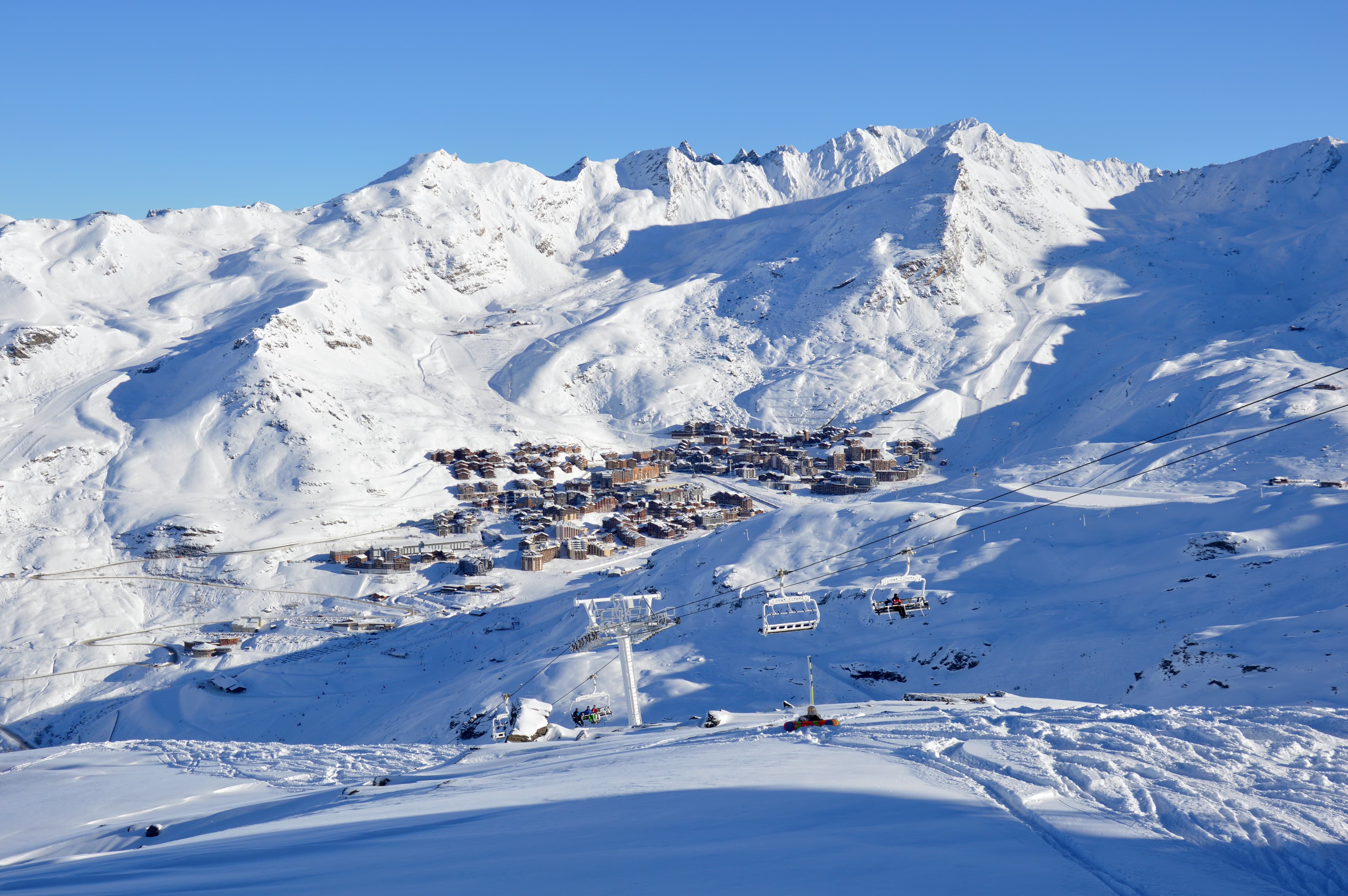
Val Thorens is the highest resort in Europe, with a base village at 7,545 feet (2,300m) and lifts reaching 10,597 feet (3,230m). The entire ski area sits above the treeline, and the 370-mile (600km) Trois Vallees ski area it anchors is the largest linked ski domain in the world.
Snow reliability here is not a question — it is a certainty. Even in the leanest snow years on record, Val Thorens maintains full coverage on its upper terrain. The season regularly runs from late November through early May.
The trade-off is that Val Thorens is a purpose-built resort without traditional village charm, and the exposed high-altitude terrain can be harsh in bad weather. When a storm rolls in at 10,000 feet, visibility drops to nothing and the wind chill can hit dangerous levels. But when you need guaranteed snow, no resort in Europe is more reliable.
Why it scores 10: Extreme altitude, north-facing upper terrain, long season, consistent snowfall patterns. Compare Val Thorens with other resorts using the comparison tool.
Tignes and Val d'Isere, France — The Espace Killy Guarantee
Tignes and Val d'Isere share the Espace Killy ski area — 186 miles (300km) of linked terrain between roughly 5,085 feet (1,550m) and 11,320 feet (3,450m). Tignes has glacier access on the Grande Motte, ensuring year-round skiing on the upper slopes.
The resort pair scores 10/10 for snow reliability because of the combination of altitude, glacier backup, and north-facing terrain on the Tignes side. Val d'Isere's famous Solaise and Bellevarde faces hold snow well through the season, and the off-piste terrain (also scored 10/10) benefits from consistent deep snow.
For US travelers who want the snow guarantee plus serious off-piste potential, Espace Killy is hard to beat. The transfer from Geneva is about 3.5 hours — longer than some alternatives — but the snow makes it worthwhile.
Why they score 10: High altitude, glacier access, north-facing bowls, consistent heavy snowfall.
Obertauern, Austria — The Snow Pocket
Obertauern is not a name most American skiers recognize, but it holds one of the most impressive snow records in the Alps. The resort sits at 5,740 feet (1,750m) directly on the main Alpine ridge, catching precipitation from both northern and southern weather systems. Average annual snowfall exceeds 16 feet (5m), and the compact ski area — about 60 miles (100km) of marked runs — is built around a bowl that traps and holds snow exceptionally well.
The resort is compact and lacks the sprawling terrain of French mega-areas, but the snow is essentially bulletproof. It also comes at Austrian prices, making it one of the best value-for-reliability combinations in the Alps.
Why it scores 10: Alpine ridge position catches weather from both sides, bowl geography retains snow, high base altitude for Austria.
Saas-Fee, Switzerland — The Glacier Village
Saas-Fee sits at 5,905 feet (1,800m) and accesses glacier terrain up to 11,810 feet (3,600m). The resort is car-free — you park at the village entrance and walk or take electric taxis — and the glacier terrain ensures snow coverage into summer.
Saas-Fee is smaller than the French mega-areas, with about 90 miles (145km) of marked runs, but the snow consistency is unmatched. The glacier holds deep coverage even in the worst snow years, and the lower slopes benefit from a north-facing aspect that preserves the natural snowpack.
Swiss pricing applies here, but Saas-Fee is somewhat more affordable than Zermatt or Verbier while matching or exceeding their snow reliability.
Why it scores 10: Extensive glacier terrain, car-free village at high altitude, north-facing lower slopes.
Tier 2: Snow Score 9/10
These resorts have excellent snow records with rare exceptions. In a typical season, coverage is complete from mid-December through early April.
Zermatt, Switzerland — The Highest Lifts in Europe
Zermatt accesses the highest lift-served terrain in Europe at 12,740 feet (3,883m) on the Klein Matterhorn. The resort's 224-mile (360km) ski area spans the Swiss-Italian border and includes glacier terrain that allows skiing 365 days a year in theory, and roughly 300 days in practice.
The iconic Matterhorn backdrop scores 10/10 for scenery — nothing else in the Alps compares. Snow reliability scores 9 rather than 10 because the lower village runs (Zermatt sits at 5,315 feet / 1,620m) can thin out in warm spells. But the upper mountain is essentially permanent winter.
Zermatt is car-free and expensive. Budget accordingly, especially for accommodation and dining. But if you want reliable high-altitude snow with genuine world-class scenery, this is the benchmark.
Why it scores 9: Extreme upper-mountain altitude and glaciers, offset slightly by a lower village base.
Lech, Austria — The Snowfall King
Lech in the Arlberg region receives an average of 18 feet (550cm) of snow per season, making it one of the snowiest resort villages in the entire Alps. The Arlberg's position relative to Atlantic weather systems means it catches heavy snowfall when moisture-laden air hits the mountains.
The resort itself is upscale Austrian — traditional architecture, excellent restaurants, family-friendly atmosphere (family rating 9/10), but with prices to match (value rating 2/10). The Arlberg ski area links to St. Anton for a combined 185 miles (305km) of terrain.
Why it scores 9: Exceptional seasonal snowfall totals driven by geographic position, high village altitude for Austria.
Ischgl, Austria — The Reliable Party
Ischgl combines a 9/10 snow reliability score with a 10/10 apres-ski rating, making it the top choice for groups that want guaranteed snow and a vibrant nightlife scene. The resort sits high in the Paznaun valley with a ski area that extends to nearly 9,200 feet (2,800m), and the north-facing terrain holds snow well into spring.
The Silvretta Arena shared with Samnaun in Switzerland offers 142 miles (230km) of terrain, and the resort invests heavily in snowmaking infrastructure as backup for the already-strong natural snowfall.
Why it scores 9: High-altitude ski area, north-facing terrain, heavy snowmaking investment.
Tier 3: Snow Score 8/10
Reliable in most seasons, with occasional lean years at lower altitudes. Snowmaking fills gaps effectively.
St. Anton, Austria — The Arlberg Legend
St. Anton is one of the most famous ski resorts in the world, and its Arlberg position delivers strong snowfall — approximately 16.5 feet (500cm) average per season. The resort scores 10/10 for both off-piste and expert terrain, and the apres-ski scene is legendary.
Snow reliability scores 8 rather than 9 because St. Anton's base village sits lower than Lech, and the south-facing runs off Galzig and Valluga can get tracked out and icy quickly after a dump. But the sheer volume of snowfall and the extensive north-facing terrain off Rendl keep the overall reliability high.
Why it scores 8: Very high seasonal snowfall, offset by a lower base and some south-facing exposure.
Flaine, France — The North-Facing Bowl
Flaine sits in a dramatic north-facing bowl in the Grand Massif area, holding 165 miles (265km) of terrain. Despite a base altitude of just 5,250 feet (1,600m), the north-facing aspect means direct sun barely touches the lower slopes during the core winter months. Snow that falls here stays here.
Flaine also scores 10/10 for family friendliness and 8/10 for value — making it one of the strongest all-around recommendations for US families who prioritize reliable snow without the Swiss price tag.
Why it scores 8: North-facing bowl preserves snowpack despite moderate altitude. Geographic snow-trap effect.
Alpe d'Huez, France — The Sunny Surprise
Alpe d'Huez is known as "the island in the sun" for its 300+ days of sunshine per year. That sounds like a snow liability, but the resort's altitude range — base at 6,100 feet (1,860m), summit at 10,925 feet (3,330m) — and extensive snowmaking keep coverage strong. The upper Sarenne glacier run, at over 10 miles (16km), is the longest black run in Europe and holds snow reliably.
Why it scores 8: High altitude compensates for sun exposure, glacier access on upper mountain, heavy snowmaking.
Month-by-Month Snow Guide
December (Early Season)
Only the highest-altitude and glacier-equipped resorts are fully open. Best bets: Val Thorens, Tignes, Zermatt, Saas-Fee. Most resorts aim for a mid-December opening, but lower resorts may only have 40-60% of terrain open.
January
The core season begins. Snowfall is typically heavy across the Alps, and even lower-altitude resorts build a solid base. January is also the cheapest month for accommodation and lift passes. Best conditions across the board — this is statistically the coldest month and new snow is frequent.
February
Peak season. European school holidays (varying by country and region) bring crowds, but snow coverage is usually at its deepest. Sun angle is still low enough to preserve conditions on most aspects. Best bets for big terrain: St. Anton, Val Thorens, Espace Killy.
March
The sweet spot for many experienced skiers. Days are longer and warmer, the snowpack is deep, and spring conditions create excellent corn snow on south-facing slopes in the afternoon. Off-piste stability often improves as the pack consolidates. Best bets: Obertauern, Lech, Val Thorens.
April (Late Season)
High-altitude resorts still deliver. Lower resorts close or thin out rapidly. Best bets: Val Thorens (open into early May), Zermatt (open year-round on glacier), Tignes (glacier stays open), Solden (glacier skiing through May).
May and Beyond
Only glacier resorts remain open. Zermatt, Saas-Fee, and Solden offer limited summer glacier skiing for those who need one more run.
Resorts to Approach with Caution in Low-Snow Years
Not every great resort is a snow-sure bet.
Kitzbuhel (snow score 4/10) sits at just 2,625 feet (800m) base altitude. The resort invests heavily in snowmaking and can manufacture coverage on key runs, but in warm December or March conditions, the lower slopes turn to slush. The famous Hahnenkamm race course is world-class, but the broader ski experience depends heavily on natural snowfall. Visit in January or February for the best odds.
Low-altitude Austrian villages like Alpbach (base around 2,950 feet / 900m) charm on every level except snow reliability. These resorts are delightful when conditions cooperate and frustrating when they do not.
The French Portes du Soleil has significant terrain below 5,000 feet (1,500m), and the connecting lifts between resort sectors can close when lower slopes lose coverage. Les Gets is a wonderful family resort, but plan for January or February rather than March if snow is your concern.
The Bottom Line
If snow reliability is your top priority — and for a trip you are flying across the Atlantic to take, it should be near the top — target resorts with a Mountain Marker snow score of 8 or above. The 10/10 resorts (Val Thorens, Obertauern, Saas-Fee, Tignes/Val d'Isere) deliver in virtually every season. The 9/10 resorts (Zermatt, Lech, Ischgl) are nearly as reliable with added character and variety.
Use Mountain Marker's comparison tool to stack snow-reliable resorts against your other priorities — terrain variety, budget, family friendliness — and find the resort that covers all your bases, starting with the most important one: actual snow on the ground.
Browse the full resort directory to see snow scores for every resort we cover.
Where to stay in Val Thorens
Browse hotels and accommodation near Val Thorens.
Find hotels on Expedia →Sponsored — we earn a small commission when you book through Expedia. It doesn't cost you more.
 Resort
Val Thorens
France
 Resort
Zermatt
Switzerland
ArticleHistorical Snowfall Data: Which Ski Resorts Are Most Reliable for Snow?
Some resorts deliver deep snow almost every season while others gamble on the weather. Mountain Marker's snow reliability scores rank the world's most consistent resorts using altitude, aspect, glacier access, and historical snowfall data. Here are the top 10 and the science behind the rankings.