beginnersfirst time skiinglearning to skiski schooleasy slopes
First Time Skiing? The 10 Best Resorts for Beginners
The Mountain Marker Team10 min read
The best European ski resorts for beginners are Flaine, Lech, Méribel, Les Arcs, and Val Gardena. These resorts stand out because they combine wide, gentle slopes with high-quality ski schools, reliable snow coverage, and enough progression terrain that you won't outgrow the resort in a week. That last point matters more than most first-timers realize: you want a resort where day one and day five both feel rewarding.
If you have never skied in Europe before, the experience is fundamentally different from learning at a US resort. European ski schools operate on a group-lesson model that is often more structured and affordable than private instruction in the States. Runs are measured in miles, not hundreds of yards. And the mountain lunch break is a two-hour affair, not a quick burrito at the base lodge. All of this works in a beginner's favor, once you know what to expect.
What Makes a Resort Good for Beginners?
Before we rank the resorts, it helps to understand what we evaluate. Not every resort with green runs deserves a "beginner-friendly" label.
Terrain Profile
The number of easy runs matters less than their quality. A great beginner resort has wide, consistently graded slopes that don't funnel into narrow paths or steep pitches. The best beginner terrain sits at mid-mountain altitude — high enough for reliable snow, low enough to avoid exposure and wind. Look for resorts with dedicated beginner zones that are physically separated from the main ski traffic.
Snow Reliability
Nothing kills a beginner's confidence faster than icy, scraped-off slopes. Resorts with high snow reliability scores ensure that the easy runs stay soft and forgiving throughout the season. Altitude helps, but so does snowmaking coverage on key beginner pistes.
Ski School Quality
European ski schools follow nationally standardized certification systems. French ESF instructors, Austrian Skischule instructors, and Italian Scuola di Sci instructors all go through rigorous multi-year training programs. For Americans, the key question is English proficiency — and at the resorts on this list, English-speaking instruction is readily available.
Progression Terrain
A good beginner resort lets you progress from the bunny slope to genuine blue (intermediate) runs within the same week. The transition should feel natural: a gentle gradient increase, not a cliff. Resorts with long, winding blue runs that descend through the treeline are ideal for building confidence.
The 10 Best Ski Resorts for Beginners
1. Flaine, France — Best Overall for First-Timers
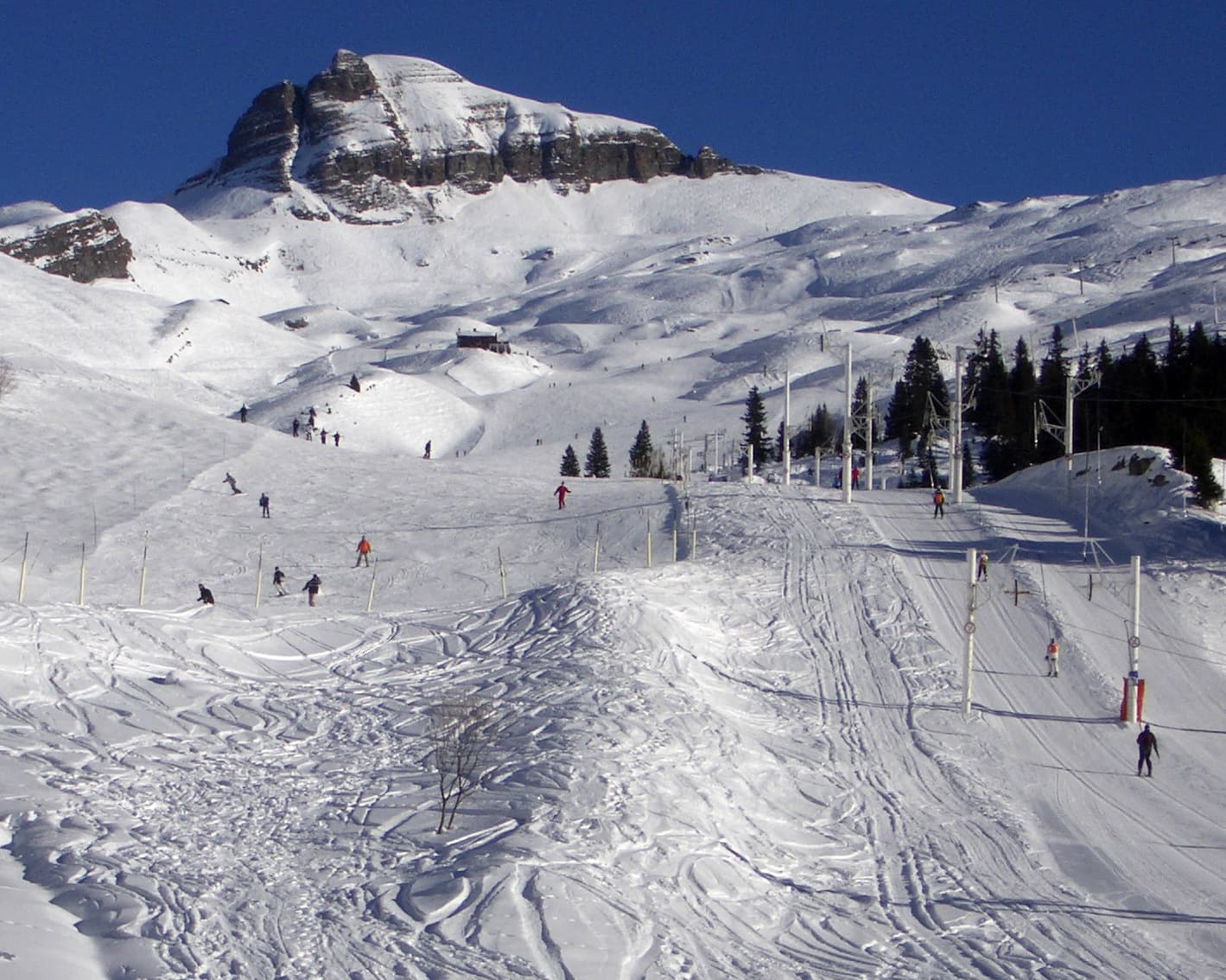
Flaine earns the top spot because it checks every beginner box. The resort scores an 8 out of 10 for beginner suitability, its ski school rates a 7, and the Grand Massif's 265km (165 miles) of pistes include a generous proportion of wide, well-groomed blue and green runs. Snow reliability scores an 8, which means you are unlikely to spend your learning week on bulletproof ice.
The beginner area sits at the heart of the resort at around 5,250 feet (1,600m), with gentle magic carpet lifts and a contained zone away from faster skiers. Once you are ready to progress, the long blue runs down to Les Carroz and Morillon are some of the best progression terrain in the Alps — wide, scenic, and rarely steep enough to trigger panic.
Flaine also scores a 10 for family friendliness and an 8 for value, making it one of the most practical choices for an American family's first European ski trip. Fly into Geneva, transfer in about 1 hour 20 minutes, and you are on snow.
Pro tip: Book your ski school lessons through the resort's ESF office at least two weeks before arrival. Group lessons fill up fast during February and March school holidays.
2. Lech, Austria — Best Luxury Beginner Experience
Lech is proof that beginner-friendly and world-class are not mutually exclusive. This Arlberg resort scores a 7 for beginner suitability and an 8 for ski school quality, with some of the best-maintained nursery slopes in Austria. The snow reliability score of 9 means the learning terrain stays in excellent condition well into April.
Lech's beginner zone near the Schlegelkopf lift is spacious, sunny, and separate from the main ski runs. The Austrian ski school tradition is strong here — instructors are patient, English is widely spoken, and the group lesson format works well for adults and children alike.
What sets Lech apart is the village itself. Family rating of 9, a pedestrian-friendly center, and a traditional Austrian atmosphere that makes the whole trip feel like an experience, not just a ski lesson. The runs connecting Lech to neighboring Oberlech and Zug are gentle enough for confident beginners by mid-week.
Practical note for Americans: Lech is significantly more expensive than French alternatives. Budget roughly 30-40% more for accommodation and dining compared to Flaine or Les Arcs.
3. Méribel, France — Best for Progression
Méribel scores a 7 for beginner suitability and a strong 8 for ski school quality. But where Méribel truly excels is in progression terrain — the intermediate score of 9 means that once you graduate from the bunny slope, you have an enormous playground of blue and easy red runs to explore.
The Altiport zone at the top of the village has a dedicated beginner area with free lifts. The runs around Rond Point are wide and gentle, and the long blue run from the top of Tougnete down to the village is one of the best "first real mountain run" experiences in Europe. With access to the full Trois Vallees area (the world's largest linked ski domain), you will not run out of terrain to grow into.
Méribel's family score of 9 reflects its well-organized childcare system, the Piou Piou children's ski school, and a village layout that keeps everything within walking distance. English is spoken more widely here than at almost any other French resort — the British connection to Méribel goes back decades.
4. Les Arcs, France — Best Value for Beginners
Les Arcs offers 425km (264 miles) of terrain in the Paradiski area, a beginner score of 7, and a family rating of 8 — all at prices that are genuinely reasonable for European skiing. The value score of 7 reflects the resort's purpose-built architecture, which keeps accommodation supply high and costs down.
Each of the four Les Arcs villages (1600, 1800, 1950, and 2000) has its own beginner area. Arc 1800 is generally the best for first-timers: the Vagere zone is flat, well-maintained, and steps from the accommodation. The progression to blue runs through the tree-lined runs above Arc 1600 is natural and confidence-building.
The Paradiski link to La Plagne gives you options for later in the week — once you can handle blue runs, the long descents on the La Plagne side are gentle and scenic.
5. Val Gardena, Italy — Best Scenery for Beginners
Val Gardena sits in the Italian Dolomites, a UNESCO World Heritage site where the jagged limestone peaks make every ski run feel like a postcard. The Dolomiti Superski pass covers 1,200km (745 miles) of terrain across multiple interconnected valleys, and a healthy share of that terrain is rated easy or intermediate.
The Seceda area above Ortisei has wide, sunny slopes ideal for beginners. The Alpe di Siusi (Seiser Alm) plateau is one of the largest high-altitude meadows in Europe — the runs here are so gentle and wide that it is nearly impossible to feel intimidated. Snow reliability is solid at altitude, and the Italian approach to mountain restaurants is the best in the Alps. You will eat better at lunch than at most dinners back home.
Cultural tip: In South Tyrol (where Val Gardena sits), the primary language is German, followed by Ladin and Italian. English is common in tourist areas. The food is a mix of Austrian and Italian influences — dumplings and pasta on the same menu.
6. Alpbach, Austria — Best Small Resort for Beginners
Alpbach is not a destination you will find in glossy ski magazines, and that is exactly the point. This small Austrian village in the Ski Juwel area is authentically traditional, genuinely affordable (value score of 7), and built around terrain that suits beginners and intermediates.
The nursery slopes in the village are flat, safe, and uncrowded. The ski school is excellent by Austrian standards, with small group sizes and patient instruction. Because Alpbach is not a destination resort, the slopes are noticeably quieter than at marquee names like Lech or St. Anton.
If you want to learn to ski in an environment that feels like a real Austrian village rather than a tourist machine, Alpbach is hard to beat. It pairs well with Innsbruck as a city-break add-on — the airport is about an hour away.
7. Alpe d'Huez, France — Best for Sun-Loving Beginners
Alpe d'Huez is famously south-facing, earning it the nickname "Island in the Sun." For beginners, this matters: sunny slopes are warmer, more forgiving, and simply more pleasant to spend a morning on when you are falling repeatedly. The resort sits at 6,100 feet (1,860m) base with a peak of 10,925 feet (3,330m), with 250km (155 miles) of terrain and a snow reliability score of 8.
The beginner area at the top of the resort (accessed by gondola) is large, flat, and bathed in sunshine. The long green and blue runs back to the village are well-groomed and wide enough that you will not feel squeezed by faster traffic.
8. Mayrhofen, Austria — Best Dedicated Beginner Mountain
Mayrhofen has a secret weapon for beginners that few other resorts can match: Ahorn, an entire mountain dedicated almost exclusively to easy skiing. The Ahorn gondola takes you from the village to a wide, gentle plateau at 6,560 feet (2,000m) where the terrain is so consistently mellow that ski schools use it as their primary teaching ground.
The main Penken side of Mayrhofen is steeper and more varied — excellent for when you progress, but not where you want to spend your first day. The clear physical separation between the beginner mountain and the expert terrain is a genuine advantage. You will never accidentally wander onto something terrifying.
Value is solid at 7, and the Zillertal valley village of Mayrhofen has an authentic Austrian atmosphere with good restaurants and lively apres-ski.
9. Obertauern, Austria — Best Snow for Beginners
Obertauern has a perfect snow reliability score of 10 — one of only a handful of resorts in the Alps to earn that rating. For beginners, this is critical. Learning on soft, consistent snow is exponentially easier and more enjoyable than scraping across icy hardpack.
The resort is laid out in a horseshoe shape, with lifts circling the valley in a natural loop. Several of the segments on this loop are gentle blue runs perfect for building mileage. The nursery slopes near the village center are flat and well-maintained.
Obertauern is not a glamorous destination. The village is small and purpose-built, without the chocolate-box charm of Lech or Alpbach. But if your priority is learning to ski on excellent snow with minimal fuss, it delivers.
10. Saas-Fee, Switzerland — Best Snow Guarantee for Beginners
Saas-Fee is glacier-backed, car-free, and scores a 10 for snow reliability. The village sits at 5,905 feet (1,800m) with glacier skiing reaching above 11,480 feet (3,500m), though beginners will stay on the lower slopes where the terrain is gentle and the snow coverage is outstanding.
The beginner area near the village is flat, sunny, and protected from wind. The progression to blue runs on the Felskinn sector is natural. As a Swiss resort, Saas-Fee is more expensive than Austrian or French alternatives, but the car-free village, stunning scenery, and snow certainty create a premium learning environment.
Practical Tips for First-Time European Skiers
Equipment Rental
Rent your equipment at the resort, not before you fly. European rental shops are excellent, the boots will be properly fitted, and you avoid the nightmare of hauling ski bags through airports. Most rental shops at the resorts on this list speak English and carry equipment from the same brands you would find in the US.
Ski School Logistics
European group ski school lessons typically run from 9:00 or 9:30 AM to noon, with an optional afternoon session. The morning session is the most important — afternoon snow conditions deteriorate, and beginners tire quickly. Book at least five consecutive days; real progress happens between days three and five.
Most resorts charge between $200 and $350 for five half-day group lessons. Private lessons cost $300-$500 per half day. Group lessons are the better value for true beginners — you learn from watching others make the same mistakes.
The Mountain Lunch
European skiing includes a long midday break, typically noon to 1:30 or 2:00 PM. Mountain restaurants serve sit-down meals — this is not a grab-and-go cafeteria culture. Budget 45 minutes to an hour for lunch. For beginners, this forced rest is actually beneficial: your legs need the break.
Altitude Adjustment
Several resorts on this list sit above 5,000 feet (1,500m), and some learning areas are above 6,500 feet (2,000m). If you are coming from sea level, you may notice mild altitude effects: faster fatigue, slight headache, increased thirst. Drink water, take it easy on day one, and skip the heavy apres-ski wine on your first evening.
Tipping
Tipping culture varies by country. In Austria, round up the bill or leave 5-10% at restaurants. In France, service is included (service compris) but leaving a euro or two is appreciated. In Switzerland, service is included but rounding up is common. For ski instructors, a tip of 10-20 euros per person at the end of a week of group lessons is a kind gesture but not expected.
How to Choose Your Resort
Use Mountain Marker's resort comparison tool to evaluate these resorts side by side on the factors that matter most to you. Filter by beginner suitability, snow reliability, value, and family friendliness to find the best match for your group.
If you are a complete beginner traveling with family, Flaine and Méribel offer the best combination of learning terrain and overall resort quality. If budget is the primary concern, Alpbach and Les Arcs deliver solid skiing at lower prices. And if you want the best possible snow conditions for your learning week, Obertauern and Saas-Fee are the safest bets.
Browse all beginner-friendly resorts on Mountain Marker's resort directory to compare scores, read detailed reviews, and start planning your first European ski trip.
Where to stay in Flaine
Discover family-friendly accommodation near Flaine.
Find chalets on Vrbo →Sponsored — we earn a small commission when you book through Vrbo. It doesn't cost you more.
 Resort
Flaine
France
 Resort
Les Saisies
France
 Article
First-Time Ski Holiday Checklist: What to Book, Pack & Know Before You Go
The complete first-time ski holiday checklist — what to book, what to pack, how much it costs, resort picks for beginners, and the etiquette rules nobody tells you. Everything you need so nothing catches you off guard.