Val d’IsèreTignesEspace KillyFrance skiingski trip comparisonFrench AlpsTarentaiseglacier skiing
Val d’Isère vs Tignes: Choosing Your Espace Killy Base
The Mountain Marker Team10 min read
Avenue Olympique in Val d’Isère — Savoyard charm at the heart of Espace Killy
Val d’Isère and Tignes share the Espace Killy ski area — 186 miles (300 km) of marked piste, 78 lifts, and some of the most reliable snow in the Alps. But the two villages could hardly be more different. Val d’Isère offers Savoyard stone architecture, Michelin-starred dining, and a legendary après-ski scene built around La Folie Douce and a string of late-night bars. Tignes sits higher, costs less, and was purpose-built in the 1960s — function over form, with direct access to glacier skiing that keeps the lifts spinning into May. Where you choose to stay fundamentally shapes your holiday, even though the skiing itself is shared. This is the comparison that will help you pick the right base camp.
The Shared Skiing: Espace Killy
The combined Espace Killy domain covers 186 miles (300 km) of piste served by 78 lifts, with a terrain split of roughly 15% beginner, 40% intermediate, and 45% advanced. A single lift pass covers both resorts, and you can ski between them freely via the Tommeuses chairlift and Col de Fresse connections.
On the Val d’Isère side, the skiing divides into three sectors. Bellevarde — host of the 1992 Olympic men’s downhill and a regular stop on the World Cup circuit — delivers steep, sustained runs from 9,514 feet (2,900m) with the famous Face de Bellevarde dropping 3,117 feet (950m) to the village. Solaise offers more forgiving intermediate terrain and excellent tree-lined runs lower down. Le Fornet, at the far eastern end, is the quietest sector and the gateway to serious off-piste routes including the classic Tour du Charvet.
On the Tignes side, the Grande Motte glacier rises to 11,318 feet (3,450m) and provides the area’s most snow-sure skiing. The Tovière sector links directly to Val d’Isère and offers a mix of red and blue runs with panoramic views. The Aiguille Percée area is a favorite for intermediates — long, rolling runs that carry you from 8,858 feet (2,700m) down to the Le Lac base. For Americans used to a single resort boundary, the sheer scale of Espace Killy is striking: you can ski for a full week without repeating a run.
Val d’Isère: The Village
Val d’Isère is a genuine Savoyard village that happens to have a world-class ski area attached to it. The main street is lined with stone-and-timber buildings, there is a handsome church at its center, and the whole place has the organic, layered feeling of a settlement that has been here for centuries — because it has. At 6,070 feet (1,850m), the base elevation is lower than Tignes, but the village compensates with character that no purpose-built resort can replicate.
The après-ski scene is legendary. La Folie Douce, perched on the mountain above the village, is where the party starts mid-afternoon with DJs, dancing on tables, and an atmosphere that lands somewhere between a nightclub and a mountain carnival. Back in the village, Dick’s Tea Bar and Cocorico keep things going well past midnight. This is not a quiet-cocoa-by-the-fire kind of resort. If après matters to you — and for many European ski trips it defines the experience — Val d’Isère delivers at a level few Alpine resorts can match.
The dining scene punches well above its weight for a mountain village. L’Atelier d’Edmond holds two Michelin stars and serves inventive Savoyard cuisine that justifies a special trip on its own. Below the fine-dining tier, excellent bistros serve tartiflette, raclette, and fondue alongside good wine lists. Expect to pay for the privilege — restaurant meals in Val d’Isère run 20–40% more than comparable quality in Tignes, and accommodation prices reflect the village’s prestige. A mid-range apartment for a family of four in peak season starts around €1,800–€2,500 per week. This is the premium end of French skiing, and the pricing makes that clear.
For American visitors, Val d’Isère represents the “complete” French ski holiday: genuine Alpine architecture, serious gastronomy, a vibrant social scene, and skiing that hosted the Olympics. It is the resort you choose when the village experience matters as much as the skiing itself.
Tignes: The Village(s)
Tignes is not one village but several sub-stations spread across different altitudes, each with its own personality. Le Lac (6,890 feet / 2,100m) and Val Claret (7,054 feet / 2,150m) are the primary bases — both purpose-built in the 1960s with the concrete, function-first architecture that defines that era of French resort development. These are not beautiful places. The buildings are blocky, the layouts are utilitarian, and the aesthetic owes more to Brutalism than to the Savoie. An ongoing renovation program is softening the edges with wood cladding and improved public spaces, but Tignes will never compete with Val d’Isère on visual charm.
What Tignes offers instead is altitude, access, and value. Le Lac sits 820 feet (250m) higher than Val d’Isère’s village, which translates to more reliable snow cover on the lower slopes. Val Claret provides the most direct access to the Grande Motte glacier — you can step out of your accommodation and be on glacier snow within 15 minutes. For skiers who prioritize snow conditions over village atmosphere, this matters more than architecture.
Below the main resort stations, Tignes 1800 (formerly Les Boisses) and Les Brévières offer a different character entirely. Les Brévières is a small, traditional Savoyard hamlet at 5,577 feet (1,700m) with stone buildings, a church, and a quieter pace. It connects to the main ski area by gondola and gives a taste of authentic village life at a fraction of the cost. Tignes 1800 sits between Les Brévières and Le Lac and has been extensively redeveloped with more modern, attractive accommodation.
For budget-conscious travelers, Tignes has one standout option: the UCPA center in Val Claret. UCPA (Union nationale des Centres sportifs de Plein Air) is a French nonprofit that runs all-inclusive sport holidays — accommodation in shared rooms, full board, lift pass, equipment rental, and group lessons included in one price. A week at UCPA Tignes typically costs €800–€1,100 per person, making it one of the cheapest ways to ski Espace Killy. It is particularly popular with solo travelers in their 20s and 30s, since the communal setup makes it easy to meet people. The rooms are basic and the vibe is more college dormitory than boutique hotel, but the value is extraordinary.
Snow and Season Length
Both resorts benefit from high altitude and north-facing aspects that protect the snowpack from sun exposure. In an average season, Espace Killy receives around 16–20 feet (5–6m) of natural snowfall, supplemented by extensive snowmaking across 900 snow cannons covering key intermediate runs and return routes to the villages.
Tignes holds a slight but meaningful edge on snow reliability. Le Lac sits at 6,890 feet (2,100m) compared to Val d’Isère’s 6,070 feet (1,850m). That 820-foot (250m) difference matters most in early and late season, when rain rather than snow can reach the lower elevations. In December and April, you are more likely to ski back to your door in Tignes than in Val d’Isère.
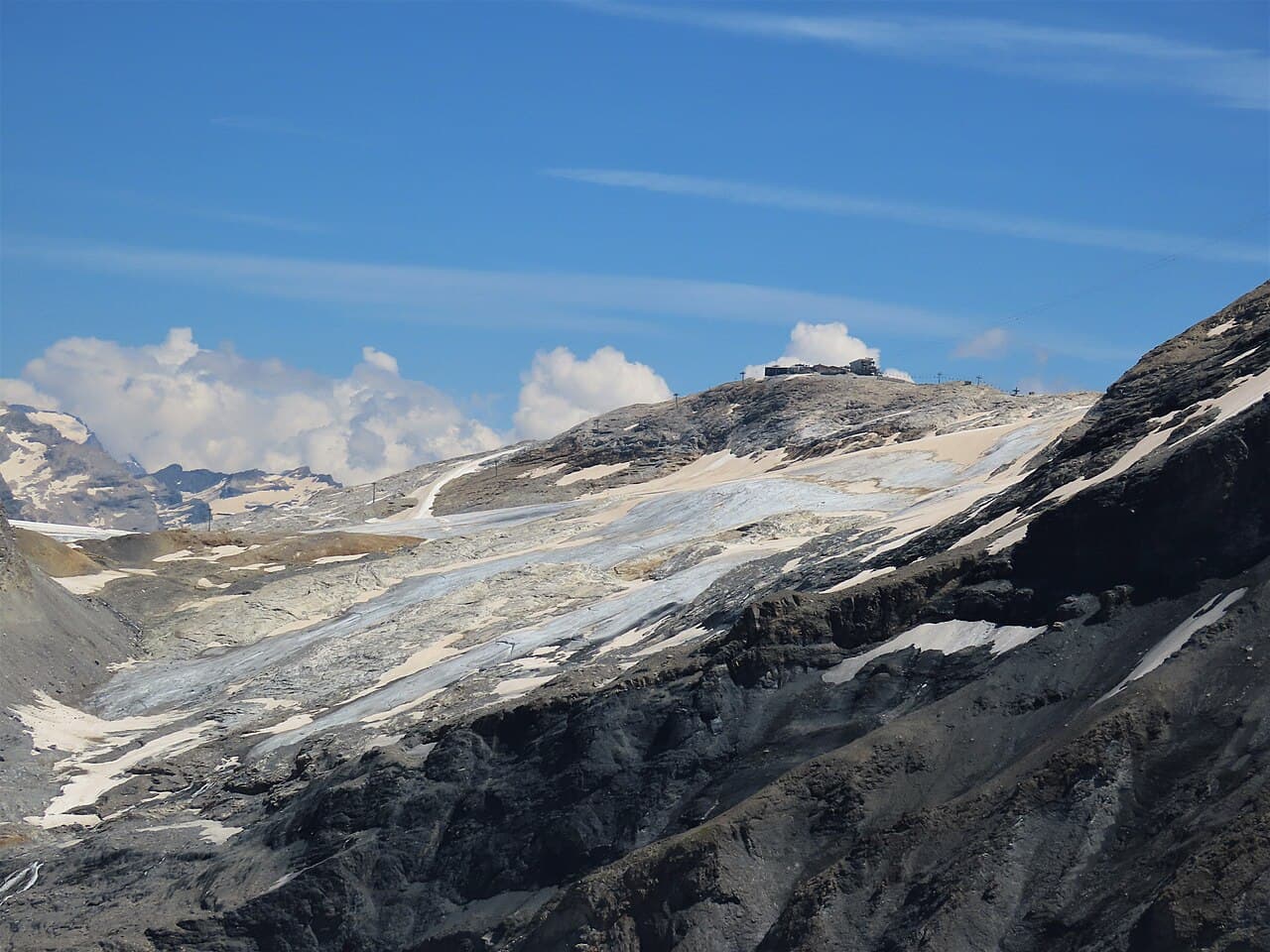
The Grande Motte glacier is the decisive factor for season length. Tignes opens in late September for glacier-only skiing and keeps the upper mountain running into early May. Val d’Isère’s season typically runs from late November through early May, with the lower sectors closing first as spring temperatures rise. If you are planning a late-season trip in April or early May, Tignes is the safer bet — the glacier guarantees skiable terrain even when the lower mountain has gone soft.
Getting There
Both resorts are accessed via the Tarentaise valley, and the logistics are identical up to the final fork in the road. The nearest train station is Bourg-Saint-Maurice (BSM), approximately 19 miles (30 km) and 30–40 minutes by bus from either resort. Direct TGV trains run from Paris to BSM on Saturdays during the season, making a morning departure from Paris feasible for an afternoon arrival on the slopes.
For flights, Geneva is the most common gateway at 3.5 hours by transfer, with Chambéry closer at 2.5 hours (though Chambéry has limited airline service, primarily budget carriers). Lyon is another option at around 3.5 hours. Several US airlines fly nonstop to Geneva from East Coast hubs, making it the most practical airport for American travelers.
One critical warning: Saturday is changeover day in French ski resorts, and the road up the Tarentaise valley from Moutiers to Val d’Isère and Tignes becomes severely congested. The 45-minute drive from BSM can stretch to 2–3 hours in weekend traffic. If your schedule allows it, travel on Friday evening or Sunday morning to avoid the worst of it. This is not minor inconvenience — it is a single two-lane road serving multiple major resorts, and the bottleneck is genuine.
Cost Comparison
Tignes is consistently 20–30% cheaper than Val d’Isère on accommodation, and the gap widens for dining and nightlife. The lift pass is identical — the Espace Killy pass covers both resorts regardless of where you stay.
Weekly Cost Estimates (per person, approximate)
| Expense | Val d’Isère | Tignes |
|---|---|---|
| Espace Killy lift pass (6 days) | €310–€340 | €310–€340 |
| Mid-range apartment (per week, family of 4) | €1,800–€2,500 | €1,200–€1,800 |
| Equipment rental (6 days) | €130–€180 | €110–€160 |
| On-mountain lunch | €18–€28 | €15–€22 |
| Dinner out | €35–€65 | €22–€40 |
| UCPA all-inclusive (per week) | N/A | €800–€1,100 |
For a family of four spending a week on the slopes, the accommodation savings alone can exceed €600–€700 by choosing Tignes over Val d’Isère. Add lower dining costs and you are looking at €800–€1,000 in total savings — enough to fund an extra ski trip. The UCPA option in Tignes makes an even more dramatic case for budget travelers: a fully inclusive week for €800–1,100 is roughly what you would spend on accommodation alone in Val d’Isère.
Who Should Choose Which
Choose Val d’Isère If:
- You want the full French ski village experience — stone buildings, good restaurants, a real sense of place
- Après-ski is a priority and you want options that run from mid-afternoon to late night
- You are a foodie willing to pay for Michelin-starred dining and excellent bistros
- You are traveling as a couple and the village atmosphere matters as much as the skiing
- This is a once-in-a-decade European ski trip and you want the most memorable resort setting
Choose Tignes If:
- Budget matters and you want to stretch your dollar (or euro) further
- Maximum snow reliability is your top concern, especially for early or late season trips
- You want glacier skiing and the option to extend your season into May
- You are a solo traveler interested in the UCPA all-inclusive center
- You are a family with young children and prefer the compact, ski-in/ski-out convenience of Le Lac or Val Claret
- Village charm is secondary to the quality of the skiing itself
The Best of Both
Remember: the same lift pass covers both resorts. Wherever you stay, you can ski the other resort’s terrain any day you choose. Some skiers base themselves in Tignes for the lower costs and higher altitude, then ski over to Val d’Isère’s Bellevarde sector two or three days during the week. You get the best skiing of both sides without paying Val d’Isère accommodation prices.
Further Reading
- Best Ski Resorts for Advanced Skiers — Val d’Isère’s Bellevarde and off-piste options earn it a place on this list.
- Best Budget Ski Resorts in Europe — Tignes and the UCPA option feature among the best-value choices in the Alps.
Browse both resorts in our resort directory, or use the comparison tool to evaluate Val d’Isère and Tignes side by side on the categories that matter most to you.
 Resort
Val d'Isère
France
 Resort
Tignes
France
 Article
Best Ski Resorts for Advanced Skiers: Expert Terrain Worldwide
Bored of groomed runs? These are the ski resorts that challenge, surprise, and reward advanced skiers — from the off-piste of Chamonix and Verbier to the freeride zones of Japan and the Americas.
 Article
Best Budget Ski Resorts: Where to Ski on a Budget in 2026
Six European ski resorts where you can ski quality terrain for significantly less than the big-name Alps destinations, with real cost breakdowns for a week-long trip.
More Guides